


Your shopping cart is empty!
Parsley leaf "Bogatyr"
New
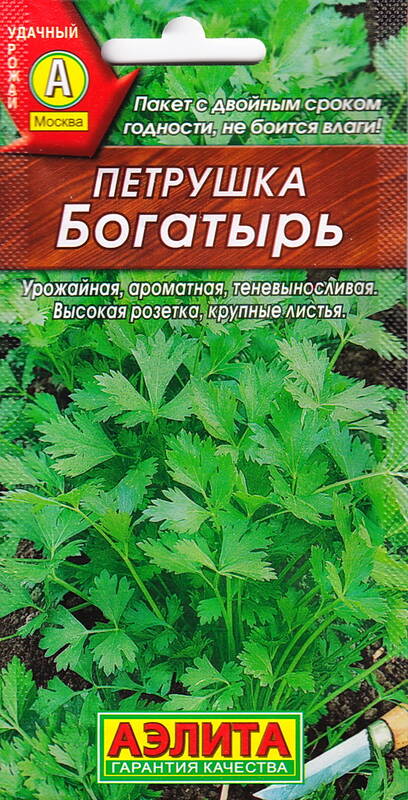
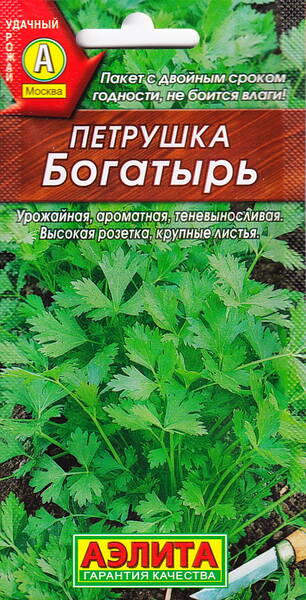
Leaf parsley "Bogatyr" - Petroselinum crispum.
It ranks first among vegetables in potassium content.
A mid-ripening leaf variety (60-75 days from germination to harvesting for greens) for cultivation in open and protected ground.
The rosette is large, 35-60 cm high, forming up to 25 leaves. The leaves are dark green, with large lobes, very aromatic, and grow back well after cutting.
The rate of green mass growth after cutting is high. The variety is characterized by shade tolerance.
The rhizomes overwinter in the soil and quickly produce fresh greens in early spring. Recommended for fresh, dried, and canned consumption.
Leaves are harvested periodically, as needed. The yield of green mass is more than 3 kg/m2.
Agrotechnology.
Parsley prefers fertile, deep-plowed, loose loamy and sandy loam soils. The best predecessors: cucumber, tomato, onion.
Seeds are sown at several times: in early spring (late April - early May), before winter (October-November), and in mid-summer (late June).
Pre-winter sowing is done with dry seeds. In the spring, parsley is sown in moistened furrows at a distance of 3-4 cm in a row and 20-30 cm between rows.
The crops are mulched on top with peat. To accelerate seed germination, the crops are covered with film, which is removed when seedlings appear. Parsley care includes weed control, two thinnings of crops, and top dressing after thinning, which is combined with regular watering.
It ranks first among vegetables in potassium content.
A mid-ripening leaf variety (60-75 days from germination to harvesting for greens) for cultivation in open and protected ground.
The rosette is large, 35-60 cm high, forming up to 25 leaves. The leaves are dark green, with large lobes, very aromatic, and grow back well after cutting.
The rate of green mass growth after cutting is high. The variety is characterized by shade tolerance.
The rhizomes overwinter in the soil and quickly produce fresh greens in early spring. Recommended for fresh, dried, and canned consumption.
Leaves are harvested periodically, as needed. The yield of green mass is more than 3 kg/m2.
Agrotechnology.
Parsley prefers fertile, deep-plowed, loose loamy and sandy loam soils. The best predecessors: cucumber, tomato, onion.
Seeds are sown at several times: in early spring (late April - early May), before winter (October-November), and in mid-summer (late June).
Pre-winter sowing is done with dry seeds. In the spring, parsley is sown in moistened furrows at a distance of 3-4 cm in a row and 20-30 cm between rows.
The crops are mulched on top with peat. To accelerate seed germination, the crops are covered with film, which is removed when seedlings appear. Parsley care includes weed control, two thinnings of crops, and top dressing after thinning, which is combined with regular watering.
* PARSLEY - Petroselinum crispum Mill.
Parsley is a more cold-resistant crop than carrots, and with some shelter, it can overwinter in the garden bed and produce greens early in the spring. You can force greens from parsley roots even in winter indoors (!).
There are two groups of parsley varieties - leaf and root. Root varieties of parsley are characterized by an even, unbranched taproot. The greens of both groups of varieties are approximately the same, however, it is no secret that many people consider the greens of curly parsley to be beautiful, but less aromatic...
All agrotechnology should be close to the agrotechnology of growing carrots. This means that parsley prefers loose, fertile soils with a soil reaction close to neutral.
It is better to prepare the bed for sowing in the fall. In the fall, the soil should be deeply dug, and in the spring it should be dug again and well loosened. Under the autumn digging, half a bucket of manure mixed with 2 tablespoons of double superphosphate and 1 tablespoon of potassium sulfate, and one glass of lime per 1 square meter should be applied.
On heavy loams in the fall, an additional 2 liters of fine sawdust should be added, which are incorporated into the soil with a cultivator to a depth of no more than half a spade. In the spring, another half a bucket of well-rotted manure or peat compost with manure mixed with 1 tablespoon of nitrophoska or half a tablespoon of potassium or sodium nitrate and a half-liter jar of wood ash per 1 square meter is applied.
Parsley seeds germinate slowly, so they are soaked in cloth or gauze for 3-4 days. As soon as some of the seeds show sprouts, they are slightly dried and sown in furrows to a depth of 0.5-1 cm. The distance between furrows is 15-20 cm, between plants - 2-3 cm. The sowing time - as soon as the earth matures - is the second half of April. An additional sowing time for greens is early July. The bed can be covered with a film so that a space of 2-3 cm remains between the film and the soil. As soon as seedlings appear, the film is removed.
During the growing season, the row spacings should be loosened, and 2-3 top dressings should be applied to the furrows in the row spacings. Top dressing is carried out at an early stage of the growing season so that the greens do not accumulate large amounts of nitrates and are not stained with mullein infusion.
In the fall, non-standard parsley roots thinner than 1 cm in diameter, or those planted in summer, are selected.
Thin root crops overwinter better. They are used to obtain greens in early spring and seeds in autumn. Root crops are either planted immediately or dug in until spring, and in spring they are planted "up to the shoulders", close to each other in a row, on a pre-prepared bed. The distance between rows is 15-20 cm.
For the winter, it is better to lightly cover parsley with pine spruce branches, since it does not crumble like spruce, and therefore protects well from mice and retains snow.
Spring planting allows you to better prepare the soil of the bed. It is advisable to carry out two or three nitrogen-potassium top dressings, then in early spring you will get excellent greens.
Keep in mind that in the second year, parsley quickly bolts. The plants should be tied up so that the wind does not scatter them...
In the second half of September, simply pull out the parsley flower stalks by the roots and lay them on a bedding in a cool room to ripen the seeds and dry them. Rub the dried umbels between your palms to separate the seeds. Pouring the seeds in a thin stream, blow away the fine debris. The resulting seeds will be enough for both planting and seasoning for food.
Plant non-flowering thin parsley root crops again to get greens early in spring and seeds in autumn.
When harvesting leaf varieties, the leaves are cut throughout the summer with a break of at least 30-40 days. Root parsley is harvested during the summer, using plants after thinning. The main harvest is carried out in September - October.
Root crops are stored in sand at high humidity and low temperature. To obtain early greens in spring, they can be left for the winter in the soil, covered with peat.